
Text by Kate Hunt

A final concert has just brought the annual Flutes in Tuscany week to a close. It was the eighth edition of this yearly get-together of both young and older flute players. The young were students studying their instrument at top music schools in both the UK and abroad. They came from the UK, from Russia, Australia and the Czech Republic. The older participants were keen amateur (but not exclusively amateur) players from the UK, and from Australia. All had the opportunity to play in the warm-ups, master classes, ensembles and concerts organised by Elizabeth Walker and Sarah Murphy, eminent flute players and teachers in their respective fields. Liz Walker is a well-known and respected player and teacher in the field of Baroque, while Sarah Murphy has a wide experience of teaching and playing both in the UK and abroad.
The music teaching and learning was taken very seriously, and everyone was able to benefit in different ways from the masterclasses and from hearing each other play. The highly skilled accompanist Aaron Burrows carried out his very demanding task with great professionalism. A very important addition to the teaching side of the week was the presence of the well-known teacher and player Karen Jones. Each of the week’s participants was treated to a valuable lesson with her. She also gave us a thrilling performance in a special concert, with Aaron Burrows accompanying her.
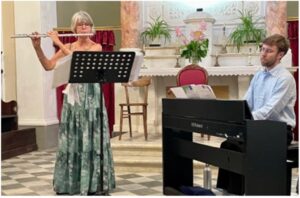
The concerts were of a very high standard and, apart from the wonderful concert given by Karen Jones, we were thrilled to hear two very promising young players. Maria Fillipova from Russia, the beneficiary of the Young Artist Award, gave a masterly concert in the setting of the Oratorio della Foce and Emily Thornton from Australia played a selection of very interesting pieces from her country.
Further highlights of the week were the concert given by Liz and Sarah. Sarah played a particularly poignant solo piece, Lament of a Sorrowing Mother, which was her own composition. Elizabeth played arrangements she had made of three songs by Richard Strauss and Edvard Grieg.
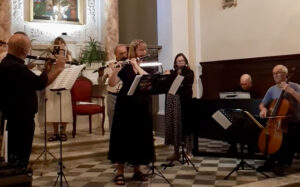
In addition, the Baroque players gave a concert that included music by Handel, Bach and Vivaldi, with Sebastian Comberti on Baroque cello and Julian Walker on piano providing the continuo. The contribution of the Italian Baroque specialist Carlo Ipata both as conductor and player added a further professional touch.
However, it was not all serious music playing. Mealtimes out on the terrace (when it wasn’t raining) gave everyone an opportunity to get to know each other and exchange stories and anecdotes. The nearby hills and villages were there to be explored. Some of the more energetic found routes for their morning runs.
Apart from getting to know each other, there was also the opportunity to get to know the villagers and find out about village life in Tereglio. Those who had a knowledge of Italian had the chance to interact with the locals. These included Giovanna, who ran the La Fagiana Hotel, Natalia who owned the shop, Claudia, who made sure we had somewhere to stay, Irene who served us our meals, Elena who ran the pizzeria and bar, and Antonella who helped Giovanna in the kitchen. Other villagers and visitors were interested in our activities and came to the concerts.
An annual event in Tereglio that often coincides with our Flutes in Tuscany Week is the lavender festival. Both villagers and visitors were invited to fill their baskets with lavender gathered from the field overlooking the valley. Drinks and homemade food were on offer and sold in aid of the restoration of the fountain and in memory of a much-loved villager called Egle, who in the past had also made us feel at home. We made our own musical contribution to the festivities by playing arrangements from Italian operas.
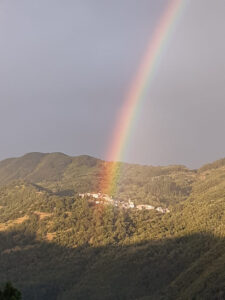
One of our last impressions of this beautiful area, and our week of flute playing, was of the rainbow that stretched right across the wooded valley.